Most of us know to get our blood pressure and cholesterol checked and to keep up with recommended cancer screenings. A professional skin exam is easier to forget. At Dermablue, we think adults over 40 should consider adding a full skin exam to their yearly health routine, especially if they’ve had a lot of sun exposure or have other risk factors for skin cancer.
Sun damage adds up
Skin cancer risk tracks closely with cumulative ultraviolet (UV) exposure. That beach sunburn from years ago counts. So do summers working outside and years of cycling, golfing, gardening or boating. Over time, this damage starts to show. Precancerous spots called actinic keratoses become more common after 40, and so do basal cell and squamous cell skin cancers.
Skin cancer can show up at almost any age. But by our 40s, most of us have decades of UV exposure behind us, and that makes regular professional checks more worthwhile.
Skin cancer is common, and catching it early changes the outcome
Skin cancer is the most commonly diagnosed cancer in the United States. The three main types are:
- Basal cell carcinoma
- Squamous cell carcinoma
- Melanoma
Basal and squamous cell carcinomas make up most cases and are usually very treatable, especially when found early. Melanoma is much less common but more dangerous, because it can spread to other parts of the body. According to the American Academy of Dermatology, five-year survival is about 99% when melanoma is caught before it reaches the lymph nodes. Survival drops a lot once it has spread to nearby tissue or distant organs.
What happens during a full-body skin exam
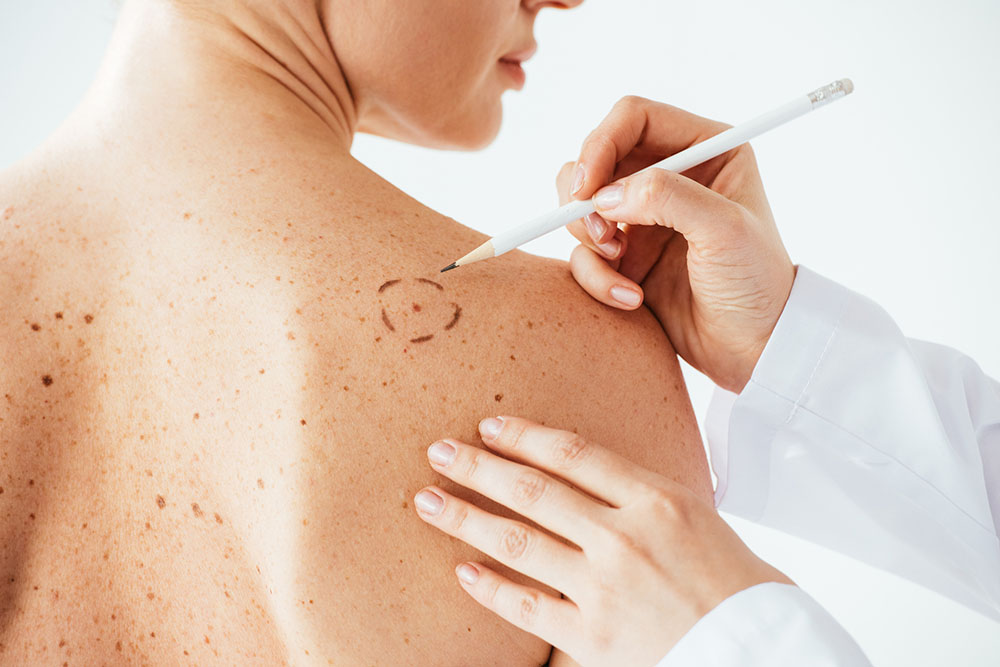
The exam is simple and noninvasive. Your provider checks your skin from head to toe for suspicious moles, growths, precancerous spots and signs of skin cancer. They pay close attention to places you probably don’t check yourself: the scalp, back, backs of the legs, ears, neck, soles of the feet, between the toes, and fingernails and toenails.
If a spot looks suspicious, your provider may examine it with dermoscopy, a magnifying tool that shows structures beneath the skin’s surface. Depending on what they see, they might suggest watching it, photographing it for later comparison, or doing a small biopsy.
Who should be most watchful
Yearly exams are especially worth considering if you have any of these risk factors:
- A personal history of melanoma, basal cell carcinoma or squamous cell carcinoma
- A parent, sibling or child with melanoma
- A lot of moles, especially 50 or more
- Atypical or irregular moles
- Fair skin that freckles or burns easily
- Red or blond hair, or light-colored eyes
- A lot of sun exposure over your lifetime
- Repeated sunburns, especially when you were younger
- Past tanning-bed use
- An outdoor job or lifestyle
- Actinic keratoses or a lot of visible sun damage
- A weakened immune system or immunosuppressive medications
- Past radiation treatment to the skin
If you have many or atypical moles, a strong family history of melanoma, a past melanoma, or a suppressed immune system, you may need exams more than once a year. Your dermatology provider can recommend a schedule based on your risk.
Darker skin tones need exams too
Skin cancer happens in people of every skin tone. Melanoma is less common in darker skin, but it’s sometimes diagnosed at a later stage. Having naturally darker skin is never a reason to ignore a suspicious or changing spot.
Know your own skin
You see your skin far more often than your dermatology provider does, so a professional exam is only part of early detection. Knowing what’s normal for you makes changes easier to spot. Try checking your skin about once a month, and watch for any spot that is:
- New
- Changing or growing
- Bleeding, itching or painful
- Not healing
- Different from your other spots
The American Academy of Dermatology also recommends watching for the ABCDE warning signs of melanoma:
- A, Asymmetry: one half looks different from the other.
- B, Border: the edges are irregular, blurred or poorly defined.
- C, Color: there are several colors, or the color is uneven.
- D, Diameter: the spot is larger than about 6 millimeters, though melanomas can be smaller.
- E, Evolving: the spot is changing in size, shape, color, symptoms or appearance.
Dermatologists also talk about the “ugly duckling” sign. A mole that looks different from everything else on your skin is worth getting checked.
Don’t wait for your annual exam if something changes
If a mole or growth changes, bleeds, keeps crusting over, won’t heal, or just worries you, book an appointment. Don’t wait for your next routine visit.
Prevention still counts
Skin exams catch problems early. Avoiding more UV damage helps prevent them. To protect your skin:
- Use a broad-spectrum sunscreen with SPF 30 or higher
- Reapply during long periods outdoors
- Wear a hat and sun-protective clothing
- Stay in the shade when UV is strongest
- Skip tanning beds
- Take extra care with the areas that get the most sun: face, ears, neck, scalp, hands, forearms and lower legs
Even if you already have a lot of sun damage, preventing more can still lower your future risk.
Add a skin exam to your yearly routine
A yearly skin exam gives your provider the chance to find suspicious spots, keep track of moles that are changing, spot precancerous sun damage, and help you make a prevention plan. If you have extra risk factors, you may need to start screening earlier or go more often.
If you’re over 40, have had a lot of sun over the years, or have other risk factors, consider scheduling a full skin exam with the Dermablue dermatology team. Skin cancer is simpler to treat when it’s caught early, and with melanoma, early detection can save your life.
If you have any general questions about skin cancer screenings, please feel free to contact us anytime! We’re here to help!
Frequently Asked Questions About Annual Skin Exams
At what age should I start getting yearly skin exams?
At Dermablue, we recommend that adults over 40 consider a yearly full-body skin exam, especially if they’ve had a lot of sun exposure. If you have other risk factors, such as a family history of melanoma, many moles, or fair skin that burns easily, you may need to start earlier.
What happens during a full-body skin exam?
Your provider checks your skin from head to toe for suspicious moles, growths and precancerous spots. That includes places you can’t easily see, like your scalp, back, ears and the soles of your feet. If a spot looks concerning, they may look at it more closely with a magnifying tool called a dermatoscope, photograph it to compare later, or do a small biopsy. The exam is simple and noninvasive.
How often should I get a skin exam if I’m high risk?
Some people need exams more than once a year. That includes people with a past melanoma, many or atypical moles, a strong family history of melanoma, or a weakened immune system. Your dermatology provider will recommend a schedule based on your personal risk.
Do I need skin exams if I have darker skin?
Yes. Skin cancer happens in people of every skin tone. Melanoma is less common in darker skin, but it’s sometimes diagnosed at a later stage. Have any new or changing spot checked, whatever your skin tone.
What should I watch for between appointments?
Check your skin about once a month. Look for spots that are new, changing, bleeding, itching, not healing, or different from your other moles. The ABCDE signs (asymmetry, irregular border, uneven color, diameter over about 6 millimeters, and changes over time) can help you spot possible melanoma. If something concerns you, book an appointment. Don’t wait for your next yearly exam.